Following your curiosity
Opening the library…
Opening the library…
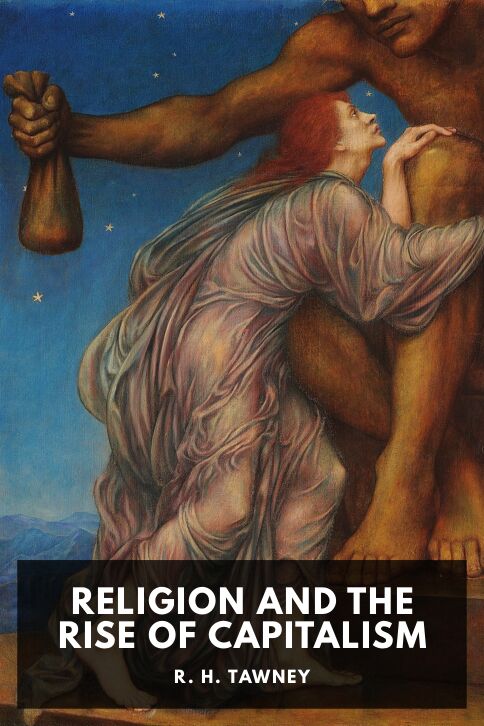
A tracing of the development of religious thought from the Middle Ages to the dawn of the Industrial Revolution.
Saved on this browser. No account needed.
The development of religious thought, and specifically how it relates to business concerns, is discussed in this classic work by R. H. Tawney. During the Middle Ages the church doctrine, notwithstanding numerous examples of inconsistencies and outright hypocrisy, viewed material wealth as a potential sign of greed, and therefore with heavy skepticism. This view permeated into discussions of economic affairs. In particular, gains coming from payment for production were viewed as acceptable, and gains from trade necessary, but gains coming from purely financial transactions (for example the charging of interest) were explicitly equated with greed, and therefore not ethically permissible and potentially punishable by excommunication. Tawney contends that this view began evolving around the time of the Reformation. He shows how the religious movements expounded by Luther and Calvin began by recognizing the legitimacy of charging interest in a limited set of circumstances. The reformed churches still initially maintained their right to comment on and criticize business practices. Charging of usurious amounts of interest, especially to people who could not afford it, was still considered a sin and something squarely within the ecclesiastical domain. With the rise of Puritanism in England, however, this view gradually faded away. Puritanism encouraged a greater reliance on individualism in spiritualism, and was less interested in policing economic transactions. This in turn led eventually to new system of values, “in which the traditional scheme of Christian virtues was almost exactly reversed,” helping to pave the way for the rise of financial capitalism and an ethical justification for extreme wealth inequality and perpetual material, instead of spiritual, growth. Even though Tawney ends his analysis at the dawn of the Industrial Revolution, it isn’t difficult to see the relevance to the modern world. Much of the language today surrounding wealth (and poverty) in particular hold an unmistakable, if not explicit, debt to Christian thought.
Publisher description · Standard Ebooks ↗ · Snapshot 2026-11-24. CC0-1.0. Not a full-book review.
Readers exploring religion and belief. This is a historical text; read its claims in the context of its time.
Reading level has not yet been assessed for this record.