Following your curiosity
Opening the library…
Opening the library…
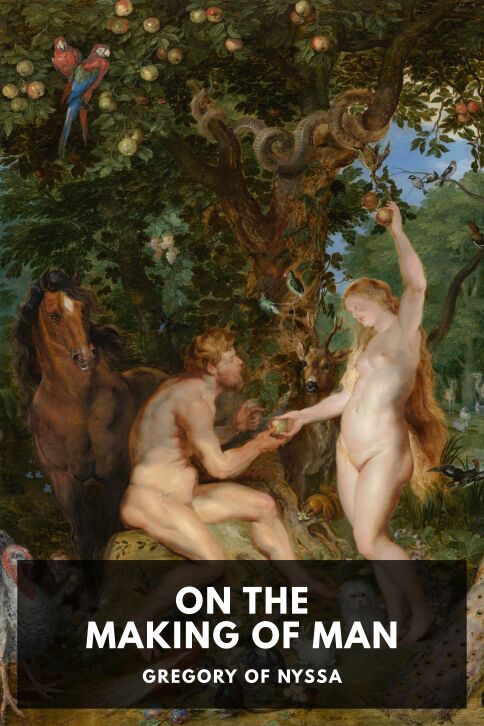
An early Christian theologian expounds on the doctrine of humanity being made in God’s image.
Saved on this browser. No account needed.
On the Making of Man is an early treatise on theological anthropology, the area of Christian theology that inquires into human nature with respect to God. In the treatise, the 4th century bishop and theologian Gregory of Nyssa interprets the creation narrative found in the first three chapters of the Book of Genesis. In particular, he expounds on the verse Genesis 1:27, the textual basis of the Christian doctrine of imago Dei (i.e. that humanity is made in God’s image). He argues that, being made in the likeness of divine sovereignty, human beings possess inherent dignity. This resemblance to God lies in humanity’s capability to possess godlike virtues, such as purity and freedom from passion. In order to refute opposing Christian and non-Christian views on human nature, Gregory ponders the soul’s relationship with the body, arguing that neither the body nor the soul preceded the other, but that both were co-created. He also argues for the possibility of the universal restoration of creation to perfection (a controversial doctrine known as apokatastasis) on the basis of the finitude of evil.
Publisher description · Standard Ebooks ↗ · Snapshot 2026-11-24. CC0-1.0. Not a full-book review.
Readers exploring religion and belief. This is a historical text; read its claims in the context of its time.
Reading level has not yet been assessed for this record.